Megan Fraser
November 2026
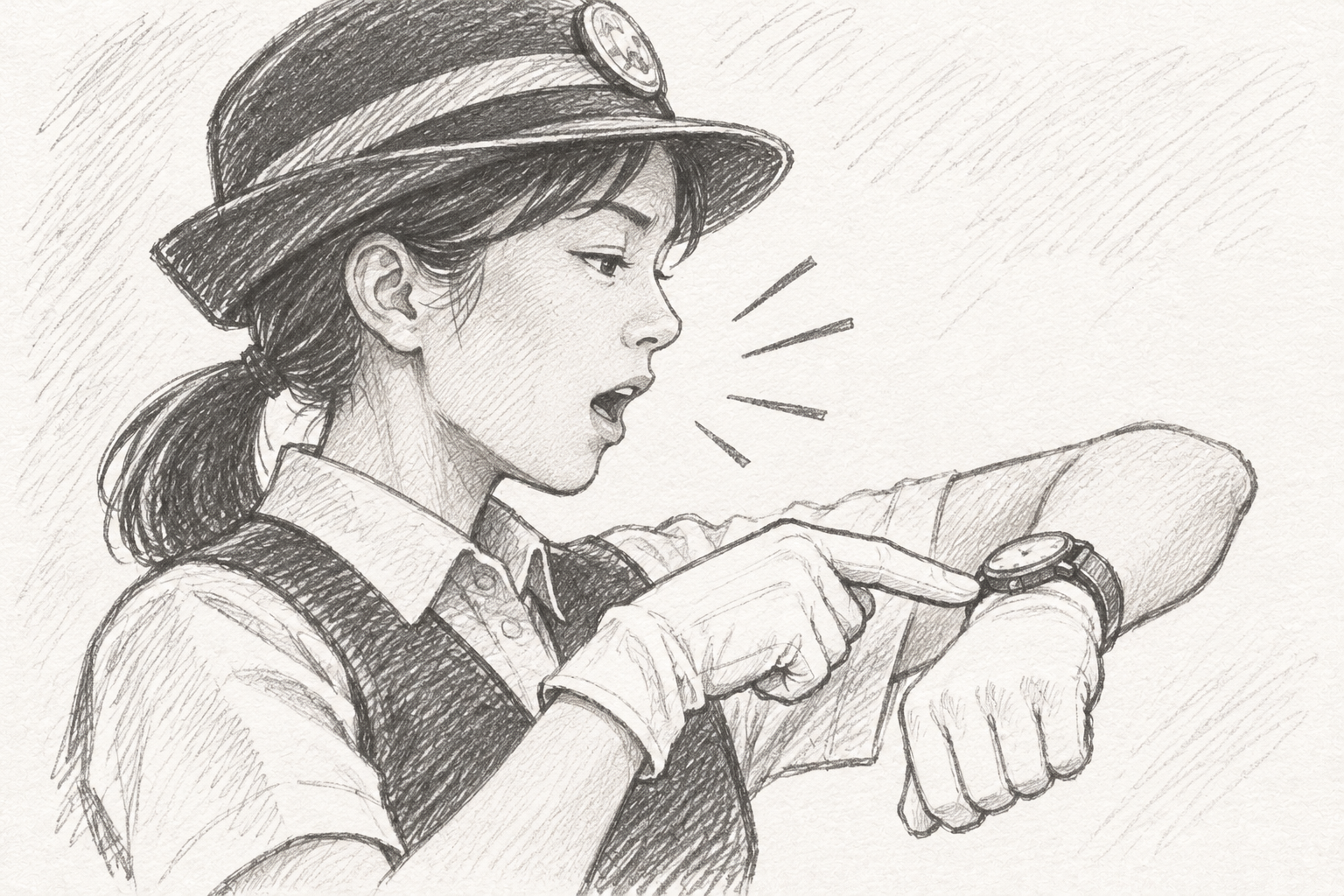
On a recent trip to Japan, I noticed some rather curious behaviour among drivers of trains, buses and even funiculars. At seemingly random times, they would intentionally pause, then go through a ritual of pointing quite dramatically at signals, instruments and their watches, calling out observations with almost theatrical precision.

What made this particularly intriguing was that they were always standing completely alone in their cabs or on the platforms, apparently talking to nobody but themselves! I couldn’t help wondering what on earth they were doing.
It turns out that this is a Japanese practice called Shisa Kanko, or “pointing and calling”. And behind this fascinating ritual lies a wonderfully simple philosophy: familiarity must never be mistaken for certainty.
 The practice originated in Japan’s railway industry more than a century ago as a way of combating complacency. When we do something often enough, our brains naturally slip into autopilot. Take driving, for example: if I think of routes I drive regularly, I often arrive at my destination with very little recollection of the journey!
Shisa Kanko is a clever way of interrupting that habit. Instead of simply glancing at a signal, the driver looks at it, physically points towards it, calls out what they see and hears their own confirmation. By involving their eyes, hands, voice and ears, they turn an almost unconscious action into a deliberate check.
And apparently, it really works!
In an experiment conducted by Japan’s Railway Technical Research Institute, the error rate in a repetitive checking task dropped from 2.38% to just 0.38% when participants used pointing and calling. That’s an impressive 84% reduction in errors, simply by making people more conscious of what they’re doing.
What I particularly appreciate about this approach is the gentle acknowledgement that we’re all human. Even the most experienced train driver can become distracted or complacent. Rather than assuming that expertise will prevent mistakes, the Japanese have developed a simple routine to help guard against them.
There’s also something rather grounding about giving the most ordinary tasks your full attention. At the heart of Zen philosophy is the idea that when you’re doing something, just do that. Whether it’s washing dishes or driving a train, the point is to be fully present in the task itself, rather than simply getting it done so you can move on to the next thing. After all, life isn’t something that happens between the ordinary things we do. It’s happening in the doing itself.
And while the pointing and calling might look like a performance, it’s really for the driver’s own benefit. A little ritual to keep the mind from wandering.
Which brings me, perhaps predictably, to investment management.
Index funds are often described as passive investments, but passive investing certainly doesn’t mean passive management. Behind the apparent simplicity of tracking an index lies a great deal of detailed, repetitive work: monitoring index changes, corporate actions, cash flows, trading costs and tracking differences. Getting these things right, day after day, takes discipline and attention.
During my trip, I would step off a train without giving a second thought to all the checks that had helped get us safely to our destination. I simply took the outcome for granted.
It’s much the same with index investing. Investors expect their fund to track its chosen index closely, and rightly so. What they seldom see is the attention to detail and discipline that make that seemingly straightforward outcome possible.
And perhaps that’s the real challenge: not paying attention when something is new, but bringing that same care and attention to the ordinary work we do a thousand times over.